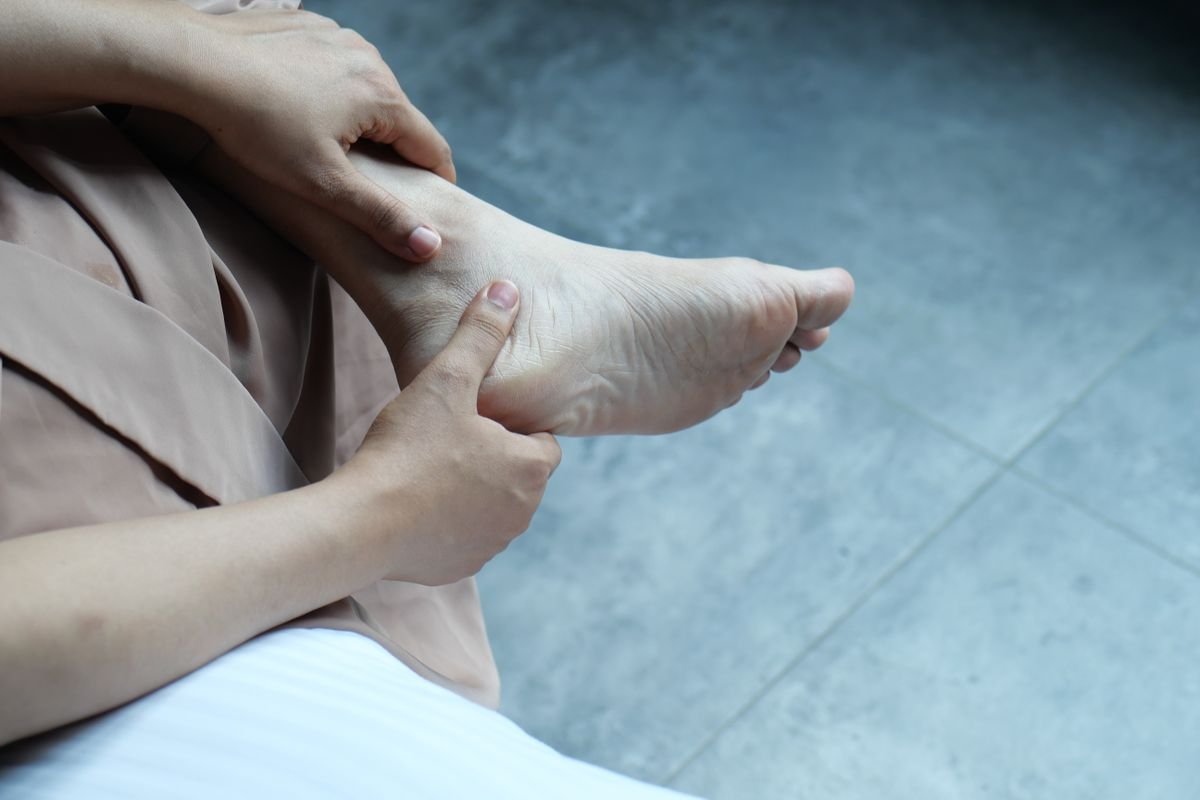
The home care with the best evidence is unglamorous: check your feet daily, wash in warm water you test with your hand, wear shoes indoors and out, and keep blood sugar controlled. Four popular remedies are risky with nerve damage — heating pads, hot soaks, going barefoot, and treating your own corns and calluses.
Search for home treatment for neuropathy in your feet and you will find the same article several times over. It is usually called something like “Top 12 Home Remedies,” it sits on the blog of a podiatry or orthopaedic practice, and if you look carefully you will notice the identical text on two or three different clinic websites. It is syndicated marketing copy, not something a clinician sat down and wrote for you.
That matters, because several of those lists recommend warm foot soaks, Epsom salts and heating pads. For most people those are harmless. For someone whose feet have lost sensation, at least one of them is the exact mechanism behind a serious burn. This page separates the two, using the published guidance from the National Institute of Diabetes and Digestive and Kidney Diseases and MedlinePlus, both part of the NIH, and quoting them directly so you can check.
What Should You Actually Do Every Day?
There is a reason the official guidance leads with inspection rather than with relief. When nerve damage reduces sensation in your feet, the warning system that normally tells you about a blister, a stone in your shoe or a seam rubbing has gone quiet. The injury still happens. You simply do not find out about it until it is bigger.
NIDDK puts it plainly: “Checking your feet each day will help you spot problems early before they get worse.” MedlinePlus is more specific about the how: “Check your feet every day. Inspect the tops, sides, soles, heels, and between your toes.”
The two-minute daily check
Do it at the same time each day so it becomes automatic — most people find sitting on the edge of the bed at night works. Use a hand mirror on the floor for the soles, or ask someone to look, if bending is difficult.
- Cuts, cracks, blisters or scrapes anywhere, including between the toes.
- Redness, warmth or swelling in one spot. Warmth in a single area is one of the earliest infection signals, and you can feel it with the back of your hand even when the foot itself feels numb.
- Colour changes — a patch that looks darker, paler or bruised.
- Nail changes — thickening, discolouration, or a nail digging into the skin at the corner.
- Dry, cracked heels. A deep crack is an open door for infection.
Washing, drying and moisturising
Both sources agree on the rule that matters most: you cannot trust your feet to tell you the temperature. NIDDK says to “wash your feet with soap in warm, not hot, water” and to “test the water to make sure it is not too hot.” MedlinePlus says to “check the temperature of the water with your hand or elbow first.” Your hand still has normal sensation. Use it.
Then dry properly. Skin between the toes stays damp, and NIDDK suggests putting “talcum powder or cornstarch between your toes” for exactly that reason. Moisturiser goes on the tops and bottoms of your feet, never in the gaps — in their words, “do not put lotion or cream between your toes because moistness might cause an infection.” It is a small distinction that almost no home-remedy article mentions.
For toenails, MedlinePlus is direct: “Cut the nails straight across. Curved nails are more likely to become ingrown.” NIDDK adds to “gently smooth each nail with an emery board or nonsharp nail file” and not to cut into the corners.
The one that outranks all of the above
If your neuropathy is diabetic, blood glucose control is not one home remedy among many — it is the only intervention with consistent evidence for slowing the underlying nerve damage rather than masking the symptom. Everything else on this page is damage limitation around it. We cover what that looks like in practice in our guide to nerve damage caused by diabetes, and the eating side in our guide to building a nerve-supportive plate.
Which Home Remedies Are Risky With Neuropathy?
This is the section that does not appear in the syndicated lists. Four things get recommended for tired, aching feet all the time, and all four change character when sensation is reduced.
1. Heating pads and hot water bottles
Both NIH sources say the same thing without qualification. NIDDK: “Do not put a hot water bottle or heating pad on your feet.” MedlinePlus: “Do not use a heating pad or hot water bottle on your feet.” The reason is simple and unforgiving — the reflex that makes you pull away from something too hot depends on the nerves that are damaged. A burn can develop while the foot feels pleasantly warm. If your feet are cold at night, wear socks to bed instead.
2. Hot soaks
The same temperature problem, with more contact time. A soak that feels merely warm to a foot with reduced sensation can be well above what the skin tolerates. If you soak at all, the water temperature has to be tested with your hand or elbow first, every time — see the next section, where the two NIH sources actually disagree about whether to soak at all.
3. Walking barefoot — including indoors
NIDDK does not limit this to outdoors: “Do not walk barefoot or in just socks – even when you are inside your home. You could step on something and hurt your feet.” MedlinePlus adds the outdoor version: do not walk barefoot “particularly on hot pavement, hot tiles, or hot, sandy beaches.” A dropped pin, a splinter from decking, hot tiles by a pool — none of these announce themselves when sensation is reduced. House shoes or slippers with a proper sole, from the moment you get out of bed.
4. Treating your own corns and calluses
This one is worth reading twice, because the products are sold openly in every pharmacy. NIDDK’s guidance is not to “cut corns and calluses” and not to use “corn plasters” or “liquid corn and callus removers.” Those removers work with acid, and on a foot that cannot report pain they can take off more than the callus. The instruction instead is to “talk with your foot doctor about the best way to care for these foot problems.”
None of this means your feet are fragile or that you should stop using them. It means the ordinary shortcuts — a bit of heat, a quick soak, padding to the kitchen barefoot, filing down a callus yourself — are the specific shortcuts to drop.
Should You Soak Your Feet or Not?
Here is something we did not expect to find, and it is worth reporting honestly rather than picking whichever answer is tidier.
The two NIH sources give different advice. NIDDK says: “Do not soak your feet because your skin will get too dry.” MedlinePlus says: “Soak your feet in lukewarm water to soften your toenails before trimming.”
They are not really contradicting each other so much as answering different questions. NIDDK is talking about soaking as a routine comfort habit, and objecting to what repeated wetting does to already-dry diabetic skin — dry skin cracks, and cracks let infection in. MedlinePlus is describing one specific, short, functional soak before cutting nails.
The practical reading, and the part both agree on: if you soak, keep it lukewarm, keep it brief, test the temperature with your hand or elbow first, dry thoroughly afterwards including between the toes, and do not make it a daily habit. Soaking is not a treatment for nerve pain. It has never been shown to repair a nerve or slow neuropathy. At best it is a comfort measure with a real downside attached.
What about Epsom salt?
Epsom salt is magnesium sulfate, and the appeal is obvious — magnesium genuinely does have a role in nerve signalling. The problem is the step in between: there is no good evidence that magnesium absorbs through intact skin in amounts that reach your nerves. Whatever comfort people get from an Epsom bath is most plausibly the warm water and sitting still, not the salt. And it carries the same two risks as any soak: temperature you cannot judge, and drying of skin that is already prone to cracking. If magnesium is what interests you, our article on magnesium and nerve pain looks at where the evidence for it is real and where it has been oversold.
What Shoes and Socks Make a Real Difference?
Footwear is the highest-leverage home change on this page, and it costs nothing to get right.
- Fit at the moment of purchase. MedlinePlus is blunt about the common mistake: “Wear shoes that are comfortable and fit well when you buy them. Never buy shoes that are tight.” The old idea of breaking a shoe in assumes you will feel it rubbing. Buy shoes that fit on day one.
- Shop late in the day. Feet swell over the course of a day. A shoe fitted at 9am can be tight by evening.
- Check inside the shoe before you put it on. Every time. Run a hand through it for grit, a folded insole, a small object. This takes three seconds and prevents a category of injury you would not otherwise notice.
- Break in new shoes gradually. Thirty minutes on the first day, then check your feet. A blister you cannot feel can be well developed by the time you take a new pair off after a full day.
- Seamless socks, changed daily. Avoid tight elastic tops that leave a mark on the calf. White or light socks have a practical advantage — drainage from a wound you cannot feel shows up on them.
- Something on your feet indoors. A slipper with a real sole, not a thin sock.
If your symptoms are also affecting your hands — which is common once foot symptoms have been present for a while — the equivalent daily-care questions are covered in our guide to neuropathy in the hands and fingers.
What Actually Helps the Pain Itself at Home?
Everything above is about preventing damage. This section is about the symptom you actually came here for.
Movement, in the right dose
Gentle, regular, low-impact activity has better evidence behind it than any home remedy on the syndicated lists. It supports circulation to the nerves and helps with the balance problems that come with reduced foot sensation. What matters is choosing activities that do not pound feet you cannot feel — our guide to exercise for nerve pain, and the movements to skip goes through both sides of that.
Topical options, and what the evidence really says
Capsaicin comes up constantly, and the honest picture is more specific than “capsaicin cream helps.” The topical with the strongest published evidence is the capsaicin 8% patch, which is licensed in the United States for painful diabetic peripheral neuropathy of the feet and for post-herpetic neuralgia. It is applied in a clinic, not at home — a single 30-minute application to the feet, with pain relief reported for up to around three months afterwards. The capsaicin creams on pharmacy shelves are typically 0.025% to 0.1%, a small fraction of that concentration and delivered differently; the research notes that outcomes appear to depend on total dose per area, concentration, application time and skin penetration. Worth asking your doctor about the patch rather than assuming the cream is a weaker version of the same thing. A June 2026 follow-up of the PACE study on the patch is covered in our roundup of neuropathy therapies tested in 2026.
The night-time problem
If your feet are worse in the evening and at bedtime, you are not imagining it, and there are specific things that help at that hour rather than in general. We cover them separately in our guide to why nerve pain intensifies at night.
Nutrients, only where a deficiency is real
Vitamin B12 deficiency is a proven direct cause of nerve damage, and correcting a confirmed deficiency can genuinely improve symptoms. The key word is confirmed — by blood test, not by guesswork. Our guide to B12 and nerve pain explains when supplementing is worth it and when it does nothing.
Nerve Fresh — a plant-based option some readers add to their daily routine
Nothing in a bottle replaces the daily foot care above, and no supplement will repair a damaged nerve. If you are exploring supplement support alongside it, Nerve Fresh is the nerve-support capsule we currently link to. Its label lists five plant ingredients (passion flower, marshmallow root, corydalis, prickly pear cactus and California poppy), and we make no claim about what it does for any specific condition.
- Plant-based capsule — five botanicals listed on the label (ingredients and doses are in our review)
- 180-day money-back guarantee (per the manufacturer) — the return has to arrive within 180 days and you pay return shipping, so read the current terms before buying
- Talk to your doctor first, especially if you take medication for diabetes
Nerve Fresh is a dietary supplement, not a medication. It is not intended to diagnose, treat, cure or prevent any disease. Our full Nerve Fresh review, pricing and refund breakdown goes through the fine print, including the look-alike sites that use the same name.
When Does Home Care Stop Being Enough?
Daily care is prevention, not treatment. NIDDK lists specific findings that mean you contact a provider rather than waiting to see how it goes:
- “A cut, blister, or bruise on your foot that does not start to heal after a few days.”
- “Skin on your foot that becomes red, warm, or painful.”
- “A callus with dried blood inside of it.”
- “A foot infection that becomes black and smelly.”
Separately from wound care, there is the question of the cause. Numbness and tingling in the feet is a symptom, not a diagnosis, and roughly a quarter of cases turn out to have no identified trigger after a full workup — but the other three quarters do, and several of those causes are treatable. If nobody has told you why your feet feel this way, that is the appointment worth making. Our guide to what numbness and tingling in the feet actually means covers what a workup involves, and our full reference on nerve damage walks through the causes one by one.

We research and compare evidence-based approaches to nerve pain relief. Nothing on this site is medical advice — always confirm decisions with a licensed clinician, especially if you have diabetes or an open wound on your foot. More about us.
Frequently Asked Questions
Can neuropathy in the feet be cured at home?
No. Nothing you do at home will repair damaged nerve fibres, and any page promising a home cure for neuropathy is selling something. What home care genuinely does is two things, both valuable: it prevents the injuries and infections that turn reduced sensation into a serious problem, and it makes symptoms more liveable. Where nerves recover at all, it is because the underlying cause was addressed — blood sugar brought under control, a B12 deficiency corrected, alcohol stopped, a compressing structure released. That is disease management, and it starts with a diagnosis rather than a remedy.
Is it safe to soak your feet if you have neuropathy?
The two NIH sources differ, and it is worth knowing that rather than being given one confident answer. NIDDK advises against soaking because it dries the skin, and dry skin cracks. MedlinePlus allows a lukewarm soak specifically to soften toenails before trimming. What they agree on is the safety rule: test the water with your hand or elbow first, because your feet cannot tell you the temperature. If you do soak, keep it lukewarm and brief, dry carefully afterwards including between the toes, and do not treat it as a daily routine. Soaking has never been shown to treat nerve damage itself.
Does Epsom salt help neuropathy in the feet?
There is no good evidence that it does. Epsom salt is magnesium sulfate, and while magnesium has a genuine role in nerve signalling, there is no reliable evidence that meaningful amounts absorb through intact skin. The relief people report is most plausibly from the warm water and from sitting still with their feet up. It also carries the two risks that come with any soak when sensation is reduced: water hotter than you can judge, and drying of skin that is already prone to cracking. If you want to try it anyway, treat it as a comfort measure, keep the water lukewarm, and test it with your hand first.
What is the fastest way to relieve nerve pain in the feet at home?
Honestly, there is no fast fix, and the search for one is where people get hurt — the heating pad is fast, and it is also the thing both NIH sources tell you not to use. The measures that help within an evening are modest: get weight off the feet, gentle movement rather than stillness, loose bedding so the sheet is not pressing on your toes, socks if your feet are cold, and a consistent bedtime routine if the pain is worst at night. Anything promising immediate relief from nerve pain is describing a different kind of pain.
Should you walk more or rest with neuropathy in your feet?
Move, but choose the surface and the shoe. Regular low-impact activity supports circulation and balance, and prolonged rest tends to make both worse. What reduced sensation changes is the type of movement: repetitive high-impact activity on feet that cannot report damage is how undetected blisters and stress fractures happen. Swimming, cycling, seated exercises and walking in well-fitted shoes on even ground are the usual choices. Check your feet after any new activity, not just after long ones.
If you take one thing from this page, make it the inspection habit. It is the least interesting item on the list and the only one that reliably prevents the outcomes people with neuropathy actually end up in hospital for. Two minutes, a mirror, every night.
Looking at supplement support alongside daily foot care?
Nerve Fresh is a plant-based capsule formula with a 180-day money-back guarantee (per the manufacturer; the return has to arrive within that window). It is an addition to the care routine on this page, not a replacement for it, and it will not heal a wound or repair a nerve. Talk to your doctor before starting any supplement, especially if you take diabetes medication.
Nerve Fresh is a dietary supplement, not a medication. It is not intended to diagnose, treat, cure or prevent any disease.
Sources cited in this article
- National Institute of Diabetes and Digestive and Kidney Diseases (NIDDK) — Diabetes and Foot Problems
- MedlinePlus (National Library of Medicine, NIH) — Diabetes — taking care of your feet
- National Institute of Diabetes and Digestive and Kidney Diseases (NIDDK) — Diabetic Neuropathy
- Anand P. et al., PubMed Central (NIH) — Reversing painful and non-painful diabetic neuropathy with the capsaicin 8% patch
- National Institute of Neurological Disorders and Stroke (NINDS) — Peripheral Neuropathy